Off the Grid and On the Air: How Young Operators Are Making Ham Radio Feel Like the Future
Photo: Adam Cuerden, Public domain, via Wikimedia Commons
A License to Disconnect
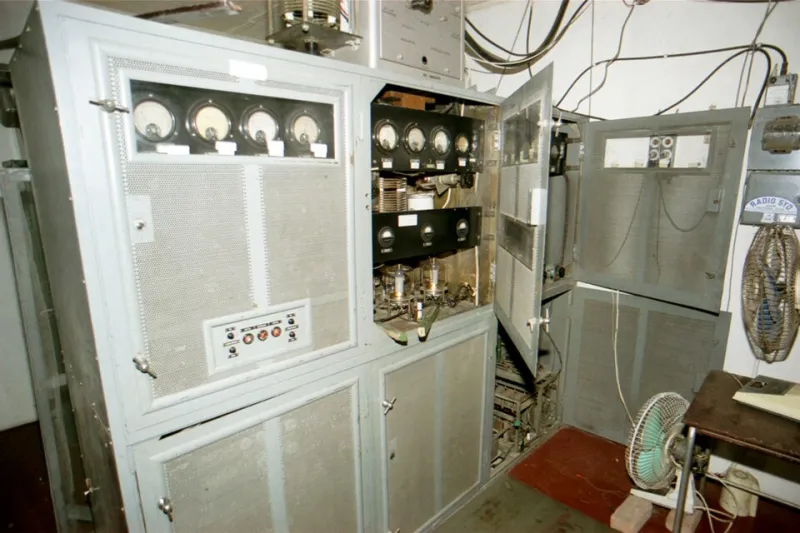
Somewhere in a suburb outside of Portland, a 22-year-old is sitting in front of a radio setup that looks like it belongs in a Cold War bunker. There's a transceiver with actual knobs — physical, tactile, analog knobs — a coil of coax cable running out the window to a wire antenna strung between two trees, and a notebook full of handwritten frequencies. She goes by Sable on the air. She got her Technician license eight months ago and upgraded to General four months after that. She is not, she will tell you immediately, interested in talking to retirees about weather conditions.
She's interested in broadcasting vaporwave to anyone within a few hundred miles who happens to be listening.
"The internet gives you reach but it takes everything else," Sable tells me over a voice call — irony noted, she acknowledges. "Ham radio gives you nothing but the signal. No metrics. No followers. No algorithm deciding if you're worth hearing. It's just you and whoever's out there."
This is not an isolated case. Across the US, a small but genuinely surprising wave of young people — Gen Z and younger millennials, mostly — are getting their amateur radio licenses, building home stations, and plugging into a mode of communication that predates the internet by decades. The FCC has issued more than 750,000 amateur radio licenses in the US, and while the overall numbers have been relatively stable, the age distribution has quietly shifted. Organizations like the American Radio Relay League have reported notable upticks in younger applicants, particularly since 2020.
The question worth asking: why now, and why them?
The Rebellion Is Analog
To understand the ham radio revival, you have to understand what these young operators are pushing back against. They grew up entirely inside the algorithmic internet — their music discovery mediated by Spotify, their social lives shaped by recommendation engines, their creative output filtered through platforms that own the relationship between the artist and the audience. The deal has always been: we give you reach, you give us your data, your attention, and your dependence.
Ham radio offers none of that reach. It also demands none of that surrender.
The appeal is partly philosophical and partly practical. On the philosophical side, there's a growing cohort of young people who are genuinely skeptical of platform dependency — who've watched enough musicians get deplatformed, enough communities get algorithm-killed, enough voices disappear overnight to want a communication infrastructure that nobody can switch off. Ham radio, operating on frequencies allocated by the FCC and governed by international treaty, is structurally resistant to corporate whims. Nobody is going to acquire it and enshittify it.
On the practical side, mesh networking capabilities built on amateur radio protocols — systems like Winlink and AREDN — allow operators to build local communication networks that function entirely without internet infrastructure. In an era of increasingly frequent natural disasters and power grid fragility, that's not an abstract concern. It's a skill set with real-world stakes.
Who's Actually Out There
The young ham radio community in the US isn't monolithic. It's more like a Venn diagram of overlapping subcultures, each arriving at the same technology from a completely different direction.
There's the experimental music contingent — noise artists, drone musicians, and ambient producers who are using ham radio as both an instrument and a broadcast medium. Some are transmitting original compositions on shortwave frequencies during scheduled listening events, creating what amounts to an appointment-based, analog-only listening party. You tune in at the right time on the right frequency, or you miss it. There's no archive. There's no replay. The scarcity is the feature.
Then there's the vaporwave and lo-fi crowd, who've found something aesthetically appropriate about a technology that sounds like it's already decayed — the static, the fading signal, the ghost-in-the-machine quality of shortwave audio. For a genre built on the aesthetics of obsolescence, transmitting over ham radio isn't ironic. It's completely sincere.
Separately, there's a more pragmatic survivalist-adjacent group who are less interested in the cultural cachet and more focused on building genuinely resilient local networks. These operators tend to be politically progressive — interested in community infrastructure, disaster mutual aid, and communications systems that aren't dependent on corporate goodwill. The overlap with community organizing spaces is real.
"We had a regional blackout last winter that knocked out cell service for about eighteen hours," says Dominic, a 25-year-old operator in western North Carolina who runs a mesh node out of his apartment. "Our local ham network stayed up the whole time. That's when a lot of people around here started paying attention."
The Learning Curve Is Real (And That's Part of the Point)
Getting into ham radio isn't like downloading an app. You have to pass an FCC exam to get licensed — the entry-level Technician test covers basic electronics, regulations, and operating procedures. It's not brutal, but it requires actual study. Equipment costs money. Setting up an antenna requires either outdoor space or creative problem-solving. The whole thing has friction built into it.
For a generation that's been sold frictionlessness as a virtue, that friction turns out to be part of the appeal. The barrier to entry filters for commitment. The people you find on the other side of it are there because they chose to be, not because an algorithm served them a recommended community. There's a self-selection that creates a different quality of connection.
"I've had better conversations on 40 meters with strangers I'll never meet than I've had in years of social media," says Sable. "Because everyone there made an effort to be there. That changes the whole dynamic."
The Signal Ahead
None of this is going to replace the internet. That's not the point, and the operators who are most interesting aren't pretending otherwise. What they're building is something more like a parallel infrastructure — a set of capabilities and communities that exist outside the dominant system and provide genuine alternatives when that system fails or disappoints.
In that sense, the ham radio revival fits neatly into a broader pattern of young people reaching backward in time for tools that the digital economy abandoned — not out of nostalgia, but out of a clear-eyed assessment of what those tools can do that newer ones can't. The cassette underground. The zine revival. The record store renaissance. And now this: a bunch of twenty-somethings in apartments across America, running wire antennas out their windows and sending music into the ether with no metrics attached.
The frequency is open. Whether anyone's listening is almost beside the point.