Dub It Yourself: The VHS Underground Keeping Censored Cinema Alive One Bad Copy at a Time
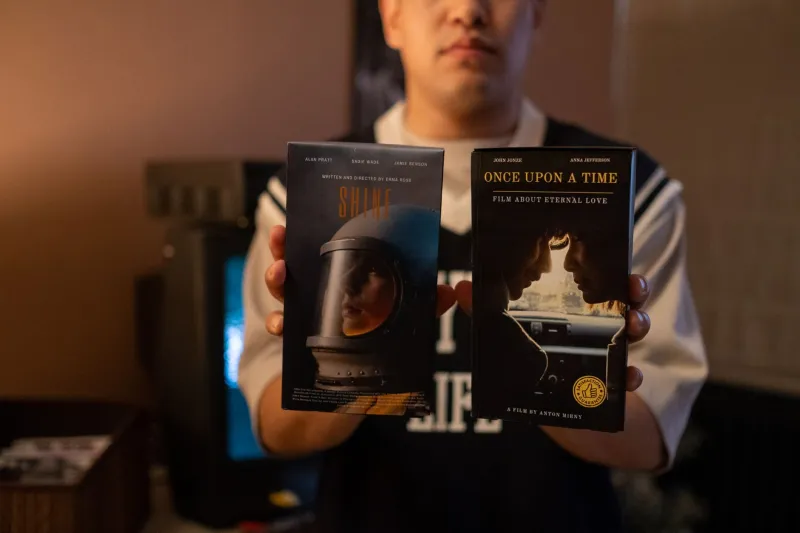
Somewhere in a basement in Columbus, Ohio, a guy who goes by Mantis is running three VCRs simultaneously. He's got a stack of blank TDK tapes on his left, a handwritten catalog on his right, and a laminator warming up in the corner for the j-cards he prints himself. He's been doing this for about four years. He's never once put a film on the internet.
"The whole point," he says over a Signal message, "is that you have to want it. You have to find it. That friction is the point."
Welcome to the VHS underground — a loose, deliberately low-profile network of tape duplicators, rogue archivists, and underground screening organizers who are quietly building a shadow cinema infrastructure that operates completely outside the streaming economy. No algorithms. No licensing deals. No content ID flags. Just magnetic tape, degraded signal, and the stubborn insistence that some films are too important — or too dangerous — to leave in the hands of platforms that can vanish them overnight.
Why VHS, Why Now
The timing makes a certain kind of sense, even if it looks absurd on the surface. We live in the most media-saturated moment in human history. You can watch almost anything, almost anywhere, almost instantly. And yet.
Streaming libraries are constantly shrinking. Licensing disputes yank films without warning. Entire catalogs get buried when studios merge or fold. Algorithms push the same fifty movies to everyone and call it discovery. And a growing number of films — politically inconvenient ones, legally complicated ones, genuinely transgressive ones — simply don't exist on any platform at all.
That's the gap the VHS underground fills. And it's a bigger gap than most people realize.
"There are films that have never been released digitally, period," says a collector in the Pacific Northwest who distributes under the name Spool Theory. "Not because nobody wants to watch them. Because nobody with money wants to deal with the rights, or the controversy, or the work. So they just... disappear. Unless someone like me keeps making copies."
Spool Theory specializes in politically charged documentaries from the '80s and '90s — films about union organizing, police brutality, and government surveillance that were once passed hand to hand on VHS and have never made the leap to any streaming service. She dubs them onto fresh tape, writes liner notes by hand, and distributes them at zine fests, film swaps, and through a closed mailing list she's been running for two years.
The Aesthetics of Degradation
Here's the thing nobody outside this world quite expects: the lo-fi quality isn't just tolerated. For a lot of people in this scene, it's the entire point.
Every generation of dubbing adds noise. Colors bleed. Edges soften. The image breathes in a way that digital files simply don't. To the uninitiated, this looks like damage. To the people seeking these tapes out, it looks like history.
"When you watch a third-generation dub of something," Mantis explains, "you're watching the evidence of every person who watched it before you. It's not clean. It's not optimized. It carries the weight of being passed around."
This isn't just aesthetics-for-aesthetics'-sake. There's a genuine phenomenological difference in how people describe watching films this way versus streaming them. Collectors talk about slowing down, about committing to the experience in a way that on-demand viewing makes impossible. You can't skip ahead on a VHS tape without losing your place. You can't watch it on your phone. You have to be present.
For an audience raised on infinite scroll and autoplay, that constraint has started to feel less like a limitation and more like a gift.
Underground Screenings and the Return of the Communal Watch
The tapes themselves are only part of the story. The bigger cultural shift is happening in the spaces where people gather to watch them.
Underground VHS screenings have been quietly proliferating across American cities for the past few years — in art spaces, basements, record stores, and the back rooms of bars that look the other way. These aren't polished repertory cinema events. They're closer to a party where someone brought a projector and a weird tape.
A collective in Chicago called Magnetic Drift has been running monthly screenings for about three years, projecting VHS dubs onto a sheet hung in a converted warehouse space. Their programming is deliberately eclectic — a censored Italian horror film one month, a suppressed labor documentary the next, an obscure regional sci-fi feature that never got distribution the month after that. The only rule is that nothing they screen is currently available on any streaming platform.
"We've had people cry," says one of the organizers, who asked not to be named. "Not because the film was sad. Because they'd been looking for it for ten years and had given up. And then there it was, on a sheet, in a warehouse, looking like a dream."
Attendance at these events tends to be small and word-of-mouth only. That's intentional. The underground screening circuit operates on trust networks — you find out about it because someone who knows you thinks you should know about it. There are no Eventbrite listings. There are no Instagram stories.
The Legal Gray Zone Nobody Talks About
It would be dishonest not to address the obvious: a lot of what happens in the VHS underground exists in legal territory that ranges from murky to clearly illegal. Duplicating and distributing copyrighted films without authorization is copyright infringement, full stop.
The people doing it know this. Most of them have thought about it more carefully than you'd expect.
The argument you hear most often is a preservation one: if a film is genuinely unavailable through any legitimate channel, and the rights holder has made no effort to make it accessible, then allowing it to disappear entirely is its own kind of harm. This is not a legally recognized defense. It is, however, a morally coherent one — and it's the same argument that has driven library archivists, film preservationists, and academic institutions for decades.
The difference is that the VHS underground operates without institutional cover. These are individuals making judgment calls, accepting personal risk, because they believe the films matter.
"I'm not bootlegging Avengers," Spool Theory says flatly. "I'm making copies of films that no corporation has any financial interest in anymore. If that's a crime, it's the least interesting crime I can imagine."
Static as a Signal
What the VHS underground ultimately represents isn't just nostalgia for a dead format. It's a working theory about what culture is for and who gets to control it.
In a world where every film, album, and book is increasingly mediated through platforms that can revoke access, alter availability, and shape what you discover through opaque recommendation engines, the act of physically handing someone a tape is almost radical. It creates a chain of custody that no server farm can interrupt. It puts the object — and the choice to seek it out — back in human hands.
Mantis is still dubbing. Spool Theory is still mailing. The warehouse in Chicago is still hanging its sheet.
The signal is degraded. The signal is still going.