Pressing Back: Why Young Collectors Are Treating Vinyl Like a Portfolio — and a Political Act
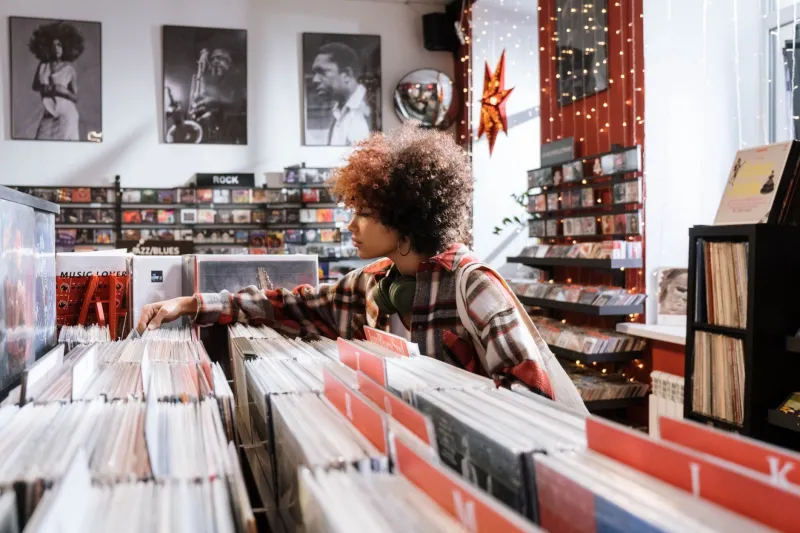
Somewhere in a Wicker Park apartment, a 23-year-old named Deja has 200 records stacked against a wall she doesn't own. She pays rent to a landlord, streams her TV, leases her phone on a payment plan, and accesses her textbooks through a subscription portal that expired the second finals ended. But those records? Those are hers. No monthly fee. No terms of service. No algorithm deciding whether she still gets to hear them.
"I own exactly two things outright," she says, half-laughing. "My cat and my crates."
This is the vinyl renaissance that nobody's really talking about — not the audiophile version, not the nostalgia angle, not the aesthetic TikTok flex. This is something stranger and more urgent: a generation that grew up inside the subscription economy quietly building a parallel system of ownership, one 12-inch slab at a time.
The Streaming Bargain Nobody Actually Agreed To
Let's be honest about what streaming did. It gave us everything and then made sure we owned none of it. Thirty million songs in your pocket, and the second you stop paying, it's gone. Your playlist history, your saved albums, your carefully curated library — all of it lives on someone else's server, subject to licensing deals you'll never read and corporate decisions you'll never influence.
For older generations, this was a miracle. For Gen Z, it was just the water they were born into. And somewhere in the process of growing up inside that water, a lot of them started to drown a little.
Marcus, 26, works at an independent record shop in East Nashville. He's watched the customer base shift dramatically over the last four years. "It used to be older dudes buying classic rock reissues. Now it's 19-year-olds coming in asking about pressings and matrix numbers. They're not here for the vibe. They're here because they want something real."
The data backs this up. Vinyl outsold CDs for the second consecutive year in 2023 according to the RIAA, with the 18-34 demographic driving a significant chunk of those sales. That's not a nostalgia market. That's a values market.
Records as Resistance, Records as Wealth
Here's where it gets genuinely interesting. A lot of young collectors aren't just buying records to listen to them — they're buying them the same way previous generations bought baseball cards, comic books, or art prints. As assets. As a hedge.
Original pressings of sought-after albums routinely sell for hundreds or thousands of dollars on Discogs, the online marketplace that has quietly become one of the most active resale economies in alternative media. A sealed original pressing of a Kendrick Lamar album. A first-issue Fugees LP. A rare regional press of something nobody else thought to hold onto. These aren't just collectibles — they're stores of value in a world where digital goods depreciate to zero the moment the platform dies.
Sophia, 24, started buying records in college and now maintains a collection she estimates at around $8,000 in resale value. She treats it like a portfolio. "I don't touch the stuff I know is going up. I flip the doubles, hold the originals. It's not that different from crypto except, you know, it's actually physical and I can listen to it."
This is a generation that watched NFTs collapse, watched crypto winter wipe out friends' savings, watched housing prices make homeownership feel like science fiction. Against that backdrop, a tangible object you can hold, sell, or bequeath starts to look like a genuinely radical financial instrument.
The Anti-Algorithm Collection
There's another dimension here that goes beyond economics. It's about curation — and who gets to do it.
Streaming platforms are, at their core, recommendation engines. They don't just deliver music; they shape taste. The algorithm learns what you skip, what you replay, what you abandon at the 30-second mark, and it builds a feedback loop designed to keep you engaged, not to challenge you. It's optimized for retention, not discovery in any meaningful sense.
Building a record collection is the opposite of that. Every purchase is a deliberate decision. You can't impulse-download a record at 2am. You have to go somewhere, talk to someone, hold the thing in your hands, decide it's worth the $25 or the $200. The friction is the point.
"My collection is actually mine," says Deja. "Spotify knows me better than my therapist and it still plays me the same six artists. My records are weird. They go in directions that don't make algorithmic sense. That's why I love them."
This is the fringe signal at the heart of the vinyl revival: it's not about warmth vs. compression, not about analog purity, not even about retro aesthetics. It's about building a relationship with music that a corporation can't surveil, optimize, or revoke.
The Community Infrastructure Around the Crate
Physical media also does something streaming fundamentally cannot: it builds community through scarcity and exchange. Record fairs, shop crawls, Discogs trading threads, the whole ecosystem of buying and selling and arguing about pressings — these are social architectures that don't exist in the streaming world because there's nothing to trade, nothing to find, nothing to lose.
Record stores have become genuine third places for a generation that's watched every other third place either close or turn into a content opportunity. You can't go viral at a record fair. You can't monetize flipping through someone's dollar bin. It's just people, in a room, arguing about whether the UK pressing actually sounds better.
Marcus has watched his shop become something closer to a community center than a retail space. "We have regulars who come in every week and buy nothing. They just want to be here. That's not a customer, that's a congregation."
Ownership in the Age of Everything-as-a-Service
The deeper you go into this community, the more it starts to feel like a philosophical position. In a culture where everything — your music, your movies, your software, your car, your razor blades — is moving toward a subscription model, owning something outright is quietly becoming an act of defiance.
It won't fix housing. It won't cancel student debt. It won't make health insurance affordable. But it's something. It's a shelf full of objects that belong to you, that no platform can deprecate, no company can delete, no terms-of-service update can revoke.
Deja puts it simply: "I could lose everything tomorrow and I'd still have my records. Nobody can stream those away from me."
In a world where ownership is increasingly something that happens to other people, that's not a small thing. That's a signal worth tuning into.