Quarter Slot Prophets: The People Who Refuse to Let America's Last Payphones Go Dark
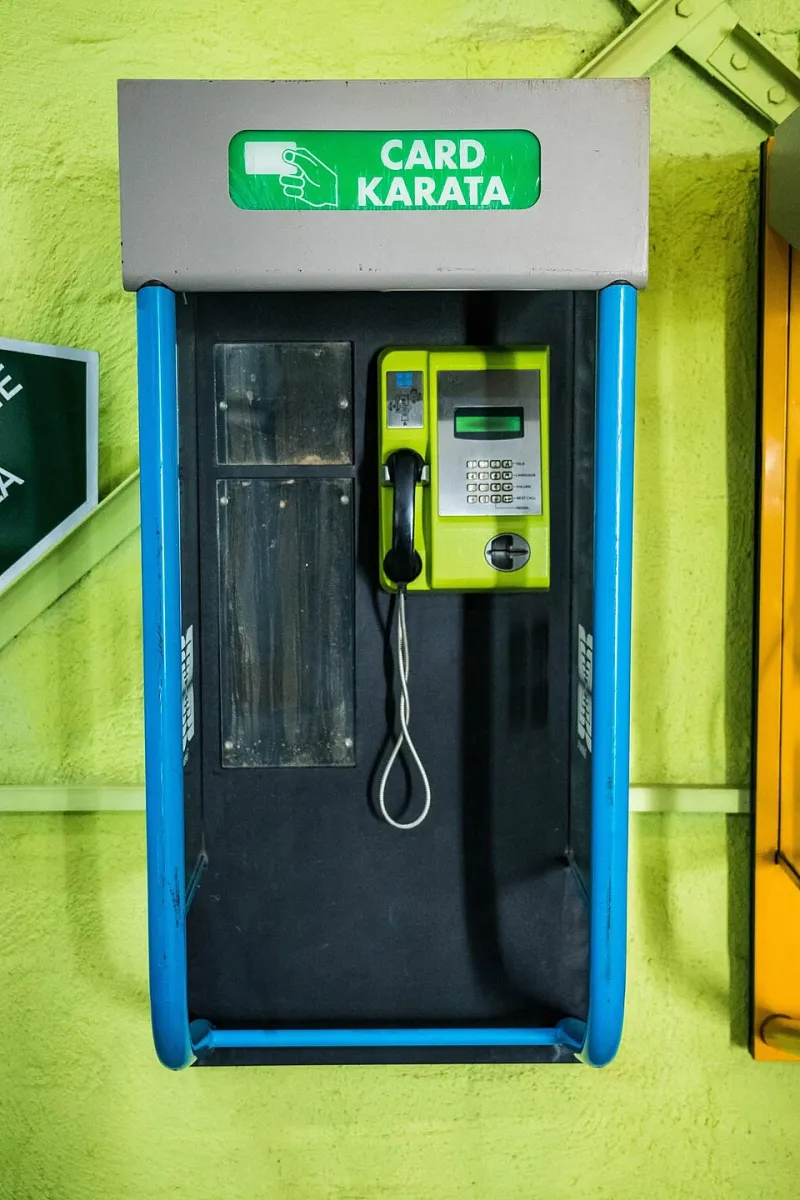
Photo: Squishypaw, CC BY-SA 4.0, via Wikimedia Commons
There's a payphone in a diner outside Bakersfield that still takes quarters. There's one in a laundromat in Queens that rings at odd hours, and when you pick it up, a stranger in another state might be on the line. There's one in a guy's hallway in Portland — an actual working payphone, bolted to the wall of a private residence — that rings into the homes of strangers who signed up for the privilege online.
These aren't museum pieces. They're nodes in a living, humming, stubbornly analog network, kept online by a loose confederation of hobbyists who communicate through forums, group chats, and word of mouth. They call themselves payphone keepers, and they are fighting a war of attrition against telecom mergers, city budget cuts, and the general assumption that the payphone went extinct sometime around 2007.
The Dial Tone Refuses to Die
Here's the thing most people don't know: payphones never fully left. The FCC stopped requiring carriers to provide them decades ago, and the big players — AT&T, Verizon, Pacific Bell — ripped out their payphone divisions like they were pulling teeth. But the infrastructure lingers. Copper pairs that were installed mid-century still run to walls in bars, motels, and apartment lobbies across the country, and as long as someone pays the line fee, that pair will carry a dial tone.
The keepers know this. Some of them have adopted orphaned payphones, agreeing to pay the monthly service charge on a line the phone company would happily disconnect. Others have bought decommissioned units at surplus auctions, wired them at home, and connected them to private line networks that let dozens of payphones ring each other directly — no internet involved.
One keeper I'll call Denny (he asked me not to use his full name; he's had run-ins with utility inspectors) maintains seven payphones across three states. Two are in public. Five are in the homes of friends who wanted, in his words, "a phone that belongs to nobody's algorithm."
Why Bother?
The obvious answer is nostalgia, and sure, that's part of it. The heft of the handset, the coin drop, the sound of an actual mechanical relay clicking over — there's a physicality to a payphone that no smartphone can replicate. But spend any time in this community and you'll find the nostalgia runs deeper than aesthetics.
A payphone is infrastructure that asks nothing of you. No account. No login. No terms of service. It doesn't track your location, doesn't ingest your contacts, doesn't serve you an ad while you wait for someone to pick up. You put in a quarter, you make a call, you hang up. The transaction ends when the conversation ends.
For a generation raised on surveillance capitalism, that's not a relic. That's a loophole.
Several keepers frame their hobby in explicitly political terms. The payphone was public infrastructure — the closest thing America ever had to a universal communication guarantee. If you had a quarter, you could reach anyone. Homeless advocates still point out that payphones were a lifeline for people without addresses, and that their removal was a quiet policy decision dressed up as market forces.
"We didn't lose the payphone because people stopped needing it," one collector told me. "We lost it because it couldn't be monetized. Somebody has to keep the proof that a network can exist just to be useful."
The War With the City Councils
Not every fight is against time. Some are against paperwork.
In New York, where the old payphone franchise agreements have been wound down in favor of Link5G kiosks, a handful of working payphones have survived on technicalities, grandfather clauses, and the sheer inertia of municipal bureaucracy. Keepers have been known to show up at community board meetings to argue for the preservation of a single unit — the last one in a neighborhood, say, or one with historical significance.
Elsewhere, the fights are stranger. Rural co-ops in a few states still operate payphones as a public service, and when budget cuts threaten them, keepers sometimes rally to cover the gap. There are documented cases of enthusiasts paying a phone company's disconnection fee out of pocket just to buy time for a unit slated for removal — then negotiating to adopt it outright.
Telecoms, for their part, mostly can't be bothered. The lines cost them more to administer than they generate, so when a keeper offers to take over the bill, the response is often a shrug and a transfer to a department that hasn't existed since the nineties. Bureaucratic limbo, it turns out, is a preservative.
The Ringing Network
The most delightful corner of this world is the informal web of payphones that call each other. Lists circulate — part directory, part treasure map — of working numbers: a booth in a Seattle dive bar, a wall unit in a Texas barbecue joint, a phone in a Chicago gallery that's technically an art installation but accepts incoming calls like any other.
People call them just to hear them ring. They leave messages. They pass the numbers along like folklore. One keeper described it as "the slowest social network ever built" — a place where the only notification is the physical jangle of a bell in a room you've never seen.
Is any of this practical? No. That's the point. In a culture where every tool has to justify itself with metrics, the payphone keepers have built something gloriously unjustifiable: a network maintained by hand, funded by quarters and stubbornness, that exists purely because letting it die felt like a lie.
The dial tone, against all odds, is still out there. Somebody's paying the bill. Somebody's listening for the ring.
And somewhere in a diner off I-5, a quarter is dropping into a slot right now.